
Angus McDonagh works appears with colourful designs and large colour
patches that recall Andy Warhol's serigraph printing paintings, it's
a branch of the pop-art that we could call post-art. Actually
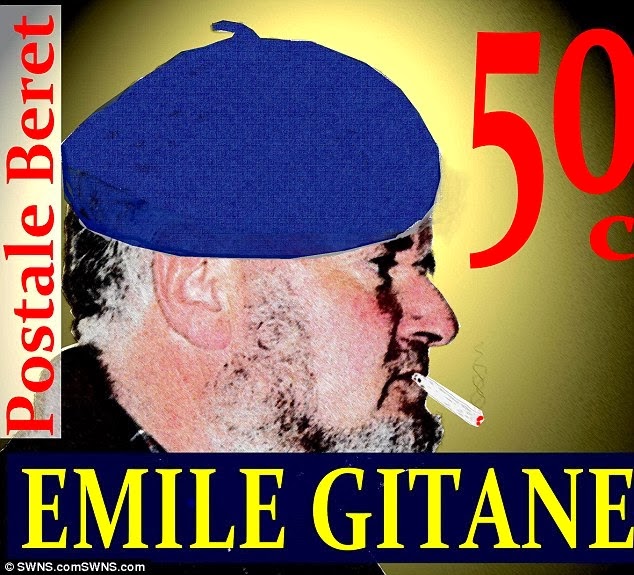
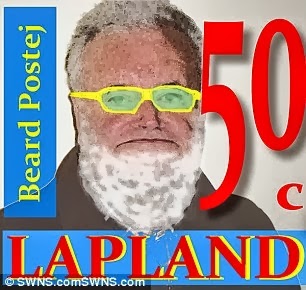
McDonagh's work consist in around 50 post stamps of simple appearance,
most of them with his own face on it, and thanks to it this Somerset
resident has been able to send letters without spending not even a
pound in stamps
 His
work started as a protest claiming against the extinction of the
stamps and ordinary mail on behalf of Internet and social media. “The
Queen’s head, it seemed to me, was going to disappear from stamps
and be replaced with lots of other images and I felt I had to act”
he told a couple of weeks ago in an interview for London free
newspaper 'Metro'.
His
work started as a protest claiming against the extinction of the
stamps and ordinary mail on behalf of Internet and social media. “The
Queen’s head, it seemed to me, was going to disappear from stamps
and be replaced with lots of other images and I felt I had to act”
he told a couple of weeks ago in an interview for London free
newspaper 'Metro'.
The
author created the stamps deliberately with a simple and silly
appearance, but still he managed to send more than a hundred letters to destinations as far as Australia, Canada or Hong Kong, with only one of
the letters being returned for having a fake stamp. Therefore are we
talking about an artist or a scammer? What do you think? Because we
know what Royal Mail thinks about it: the British national post
company insists it is an offence both the creation or use of fake
stamps and so they want to take actions against this case. Although
on the other hand it was Royal Mail who was supposed to detect the
fake stamps during this last three years.
It
should be also said that Angus McDonagh never wanted to avoid the
postal costs and he tried to send checks to the post company, but
those have been returned. If that is so, instead of a criminal can we
see here an artistic protest, a Banksy of the mail services? Or even
a better question: Royal Mail's reaction would be the same if it was
Banksy whohad played this “scam”?
 Precisely
one of the last activities of Banksy in his new period in New York
has been to sell his own artworks in a street stand, like the ones
that usually sell fakes of his art. What is the difference between
them to say that Banksy is an artist and McDonagh isn't? Both of
them create original material to supplant as a protest; non of them
looks for the economic profit (proceeds from the sale of originals in
New York, at $ 60 a piece, were all for the shopkeeper). But beware!
Banksy hasn't forced a national company to lose profits, only
four strangers who were redecorating their home have lost some money.
Does that mean McDonagh is an example that in Art, as in everything,
you must be careful who are you protesting against to?
Precisely
one of the last activities of Banksy in his new period in New York
has been to sell his own artworks in a street stand, like the ones
that usually sell fakes of his art. What is the difference between
them to say that Banksy is an artist and McDonagh isn't? Both of
them create original material to supplant as a protest; non of them
looks for the economic profit (proceeds from the sale of originals in
New York, at $ 60 a piece, were all for the shopkeeper). But beware!
Banksy hasn't forced a national company to lose profits, only
four strangers who were redecorating their home have lost some money.
Does that mean McDonagh is an example that in Art, as in everything,
you must be careful who are you protesting against to?
It
comes out again the big question “What is Art?” and one of the
most plausible and indefinite answers is: “Art is what the somehow
(culturally, economically, politically...) more powerful decide that
is Art”. It is not everyone's decision, not mine, to decide if
McDonagh is an artist, that's a decision for the ones who, sometimes
without us knowing completely, decide so much for us. Under that
point of view contemporary art is not such a different thing from the
Renaissance or Romanticism art, where the great artists were the ones
who pleased better their patrons or exalted with better grace the
bourgeois class. The trick must be to please who must be pleased and not criticize what mustn’t be criticized.
Ricard Gispert

